
The Sentencing Act 2026 introduces important changes to the point at which some prisoners serving adult standard determinate sentences may be released. These changes are being brought into force in stages by The Sentencing Act 2026 (Commencement No. 4) Regulations 2026.
At Driscoll Young Solicitors, we specialise in criminal defence work. We understand that changes to sentencing and release rules can cause real concern for clients, families and friends. The rules are technical, and whether a person is affected depends on the type of sentence, the date it was imposed, the person’s custody or licence status, and the length of the sentence.
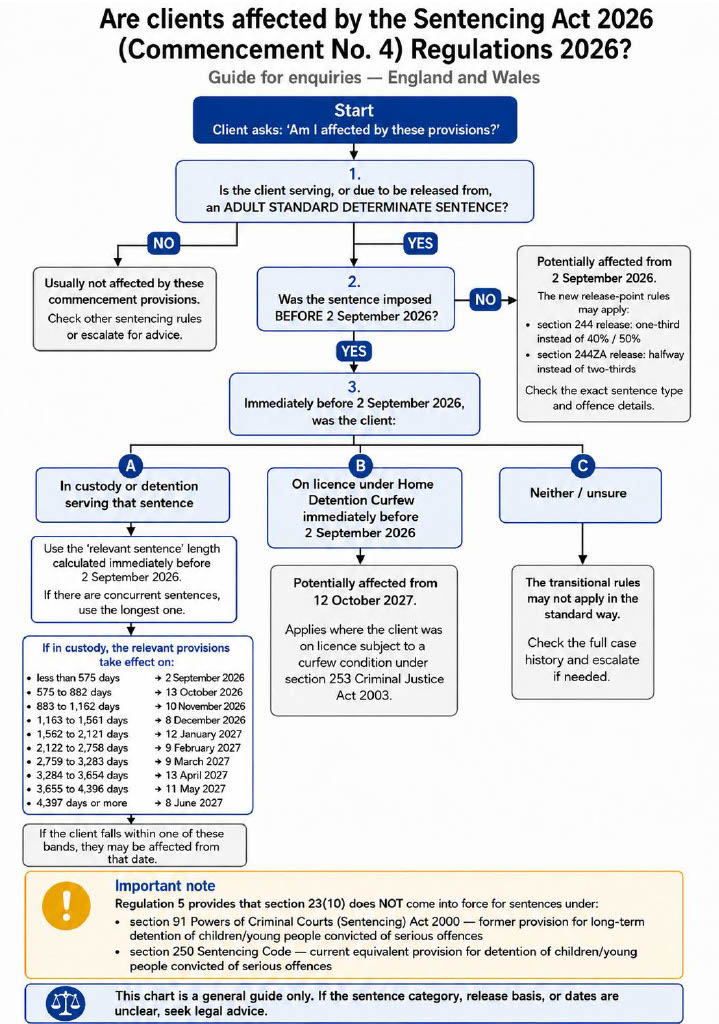
We have prepared the flow chart below to help explain the main questions that need to be asked.
What is changing?
The new provisions mainly affect people serving adult standard determinate sentences.
In simple terms, the changes reduce the point at which some prisoners may become eligible for release:
- for some sentences, the release point changes from 40% or 50% of the sentence to one-third;
- for some other sentences, the release point changes from two-thirds to the halfway point.
These rules do not apply to every prisoner. They are not a blanket reduction for everyone in custody.
Who may be affected?
A person may be affected if they are serving, or are due to be released from, an adult standard determinate sentence.
The key questions are:
- What type of sentence is the person serving?
- Was the sentence imposed before or after 2 September 2026?
- If the sentence was imposed before 2 September 2026, was the person in custody immediately before that date?
- Was the person already on Home Detention Curfew immediately before that date?
- What is the length of the relevant sentence?
- Are there any concurrent sentences?
- Does the case involve a youth sentence that falls outside part of the commencement provisions?
These are not always straightforward questions. In some cases, the sentence calculation will need to be checked carefully against the court order, prison records and release provisions.
When do the new rules come into force?
The main date is 2 September 2026.
However, for people who were already serving a sentence before that date and were in custody immediately before 2 September 2026, the changes are phased in over time.
The date depends on the length of the relevant sentence. For shorter sentences, the provisions may apply from 2 September 2026. For longer sentences, the commencement date may be later, running through to 8 June 2027.
There is also a separate rule for people who were already on licence under Home Detention Curfew immediately before 2 September 2026. For that group, the relevant provisions may not come into force until 12 October 2027.
What about people who have already been sentenced?
This is one of the most important practical issues.
The change to the release point does not mean that the sentence imposed by the court has been changed. The sentence length remains the sentence length.
The new rules may affect how the custodial part of the sentence is calculated for release purposes, but they do not automatically reopen every sentence or change every order made by the court.
If someone has already been sentenced, it is important to check:
- the type of sentence imposed;
- the date of sentence;
- the applicable release provision;
- the current release calculation;
- whether the person is in custody, on licence, or on Home Detention Curfew;
- whether any appeal or correction route may be available.
What about driving disqualifications?
The Sentencing Act 2026 also brings in related changes affecting some driving disqualification extensions.
Where a court imposes a driving ban alongside a prison sentence, the law can extend the disqualification to take account of the time the person is expected to spend in custody. This is intended to stop a driving ban from being used up while the person is still in prison.
Because the release points are changing for some sentences, the rules dealing with driving disqualification extensions also need to align with the new custodial periods.
However, this does not necessarily mean that an existing driving disqualification is automatically reduced.
If a client has already been sentenced and already has a driving disqualification, the safest approach is to obtain advice. It may be necessary to consider whether the disqualification was correctly calculated, whether the sentence can be challenged, or whether any appeal or correction route is available.
Youth sentences
There is also an important exception relating to certain youth sentences.
The regulations state that section 23(10) of the Sentencing Act 2026 does not come into force for sentences under:
- section 91 of the Powers of Criminal Courts (Sentencing) Act 2000, which was the former provision for long-term detention of children and young people convicted of serious offences; and
- section 250 of the Sentencing Code, which is the current equivalent provision for detention of children and young people convicted of serious offences.
This means extra care is needed where the sentence concerns a child or young person, or where the sentence was imposed under these provisions.
Why legal advice matters
Sentence and release calculations are often more complicated than they appear.
A person may have more than one sentence. Sentences may be concurrent or consecutive. The release provision may depend on the offence, the date of sentence, previous legislation, and the way the court imposed the sentence. In some cases, a client may also be affected by recall, licence conditions, Home Detention Curfew, deportation provisions, or driving disqualification rules.
For that reason, it is risky to rely on a general summary alone.
At Driscoll Young Solicitors, we regularly advise clients involved in criminal proceedings and understand the practical importance of sentence calculation, release dates and post-sentence consequences. If you or a family member is unsure whether the Sentencing Act 2026 affects a sentence, we can review the position and provide clear advice.
How Driscoll Young Solicitors can help
We can assist with:
- checking whether the new release provisions apply;
- reviewing the sentence imposed by the court;
- considering release date calculations;
- advising on driving disqualification issues linked to custodial sentences;
- identifying whether an appeal or correction route may be available;
- advising families who are trying to understand what the changes mean for someone in custody;
- providing urgent advice where a release date or licence issue is unclear.
Speak to a criminal defence solicitor
If you are worried about how these changes may affect you, a family member, or someone currently in custody, contact Driscoll Young Solicitors for specialist criminal defence advice.
The earlier the sentence and release position is checked, the easier it is to identify whether the new rules apply and whether any action can be taken.
Contact Driscoll Young Solicitors today to speak to a criminal defence solicitor.
This article is intended as general information only and should not be treated as legal advice. The effect of the Sentencing Act 2026 depends on the individual facts of each case.